Life on a Farm and Relationships: What Love Really Looks Like

When your partner is also your farmhand, love takes on a meaning most people never experience. Real stories from farm couples across America.

Farm life and romantic relationships are inseparable in America. Over 90% of the nation's 2 million farms are family operations, typically run by a couple - married or not (USDA Census of Agriculture, 2022). That means for the vast majority of farmers, a relationship is not just personal fulfillment. It is the foundation of their livelihood. The farm couple is a working unit: one person drives the tractor while the other manages the books, one tends livestock at 4 AM while the other gets the kids ready for school. This article explores what countryside romance actually looks like - the beauty, the tension, and the honest realities that no dating app bio can capture.

Key Truths About Farm Relationships

  • Farming is a relationship business. Over 90% of U.S. farms are family-run - your partnership literally powers the operation.
  • The farm sets every rhythm. Dates, vacations, and even arguments are scheduled around planting, harvest, and livestock needs.
  • Finances are uniquely complex. A farmer may own $2 million in land and equipment yet have $800 in their checking account.
  • It is a partnership, not just dating. Farm couples who thrive treat their relationship with the same intentionality they give their crops.

90% of Farms Are Family Operations - Relationships Are the Foundation

The family farm is not a nostalgic relic. It is the dominant model of American agriculture in 2026. According to the USDA Census of Agriculture, over 90% of the nation's farms are family-run, and on more than half of those operations, at least one partner earns income off the farm to keep the household financially stable. This dual-income reality means farm couples are juggling two worlds simultaneously.

What does this mean in practice? A farm relationship is not just about love - it is about operational survival. When one partner handles morning livestock chores and the other manages direct-to-consumer sales at the weekend farmers' market, the relationship is embedded into every aspect of the business. Problems between partners do not stay at the dinner table. They follow you into the barn, the field, and the balance sheet.

"If you marry a rancher, you marry the work. It is 24 hours a day, 365 days a year."

- California cattle rancher, Civil Eats

This is why platforms like Farmstead Singles exist. Generic dating apps connect people who share a zip code. Farm dating connects people who share a way of life. If you are curious about finding that kind of partner, our guide on how to date a farmer covers the practical first steps.

The Farm Sets the Schedule for Everything - Including Love

The rhythm of a farm dictates the rhythm of a relationship. There is no separating the two. Unlike a 9-to-5 job that ends when you leave the office, farming follows the sun, the seasons, and the animals - none of which respect your anniversary dinner plans.

Here is what the farm calendar means for couples:

  • Spring planting (March-May): 14-16 hour days. Communication shrinks to quick texts and exhausted evenings. Partners who take this personally will struggle.
  • Summer growing (June-August): The pace eases for crop farmers. County fairs, barn dances, and long evenings on the porch - this is when farm romance thrives.
  • Fall harvest (September-November): All-hands-on-deck. A farmer may vanish for weeks. The best thing a partner can do is show up with dinner at the field.
  • Winter (December-February): The quiet season. Livestock still needs daily care, but crop farmers have dramatically more flexibility. This is when farm couples reconnect.

The seasonal nature of farm dating creates a unique pattern: couples often feel like they are in a long-distance relationship during peak seasons, even when they live under the same roof. For a deeper look at how to navigate these cycles, read our article on seasonal dating challenges.
From San Francisco to a Small Town: Lisa and Will's Story

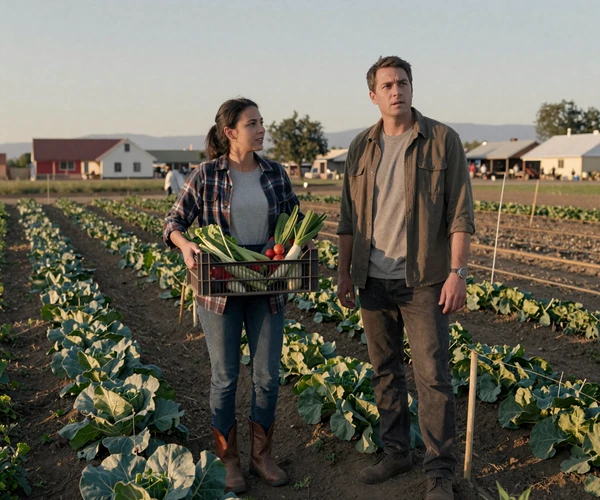
Not every farm love story has a happy ending - and the honest ones deserve to be told. Lisa and Will were profiled by Civil Eats after moving from San Francisco to a rural California town of 3,000 people so Lisa could pursue her dream of farming. Will, who had worked in tech, was not prepared for the workload or the financial strain.

Will took freelance tech gigs to pay the bills while Lisa worked the land. The isolation was crushing. The nearest grocery store was a 40-minute drive. Friends stopped visiting after the first year. Lisa shared with painful honesty: "He hates me for making him come. And I hate him for not wanting to stay."

Their story is a cautionary tale, but also a deeply common one. Only about 1% of the U.S. population farms for a living, which means the vast majority of potential partners have never experienced rural isolation, seasonal income swings, or the physical demands of agricultural work. When one partner is drawn to farm life and the other is not, the gap can become a canyon.

The lesson? Compatibility on a farm is not about shared hobbies or favorite restaurants. It is about shared tolerance for discomfort, financial uncertainty, and distance from the conveniences most Americans take for granted. If you are a city person considering a move to the country, our California farmers dating page has more on what to expect.

Couple on a small California farm adjusting to rural life after moving from the city - farm relationships

Gender, Motherhood, and the Modern Farm Partnership

Gender roles on a farm are evolving - but not as fast as in urban America. Hayley, a farmer on an organic dairy operation in Maine, holds a bachelor's degree in agronomy and a master's in International Agriculture Development from UC Davis. She is, by every credential, a farmer. But after having children, the reality shifted dramatically.

"Now my husband Rick is mostly outside with the animals, and I am inside with the kids," Hayley told Civil Eats. "Sometimes I see him when he walks past the kitchen window." Customers at the local farmers' market refer to Rick as "the real farmer" and to Hayley as "just the farmer's wife" - despite her being the more educated and experienced operator.

The childcare gap is real. Hayley started seeing a therapist for depression after being sidelined from the work she loved. Her message to other farm parents: "Farming with a family only works if you have childcare and community support, and most of us have neither."

This is not an isolated experience. On family farms across the Midwest and New England, women often manage bookkeeping, marketing, and direct sales while men handle field operations and livestock - a division that can feel natural or suffocating depending on whether it was chosen or imposed. The modern farm partnership requires honest conversations about who does what, and why.

Farm Finances: When Wealth Is in the Land, Not the Bank

Farm finances are unlike any other household's financial picture. A farm couple may sit on $2 million in land and $500,000 in equipment while having less than $1,000 in liquid cash. According to the USDA Economic Research Service, 63% of farmers have a primary job off the farm - meaning the farm itself often does not generate enough income to support a family.

Here is where it gets interesting: this financial structure creates unique stress in relationships. Consider these realities:

Financial Factor Farm Couple Urban Couple
Primary asset Land and equipment (illiquid) Savings, 401(k), home equity
Income pattern Seasonal - big checks 1-2x/year Biweekly paycheck
Unexpected expenses Equipment failure ($10K-$50K+) Car repair, medical bills
Debt profile Operating loans, land mortgages Student loans, credit cards
Retirement plan Sell the farm or pass it down Pension, IRA, Social Security

Young livestock farmers in the Civil Eats report described the financial reality bluntly: "Money in agriculture was slow and the labor involved could be brutal." Will, from the Lisa and Will story above, ended up taking freelance tech gigs just to cover basic household bills while the farm found its footing.

The bottom line: farm couples who survive financially are the ones who talk about money openly, budget for worst-case seasons, and accept that wealth on a farm looks very different than wealth in a city. If the financial realities of farming interest you, our guide on how to date a farmer covers what to discuss before getting serious.

Making Time for Romance: Quiet Season Strategies

The couples who make farm relationships work are the ones who treat romance with the same intentionality they give their crops. You would not skip irrigation during a dry spell - so do not skip quality time during a slow week.

Practical ideas that real farm couples swear by:

  • Winter date nights: December through February is the golden window. Plan actual dates - not just collapsing on the couch. Dinner in town, a movie, even a weekend getaway while a neighbor watches the animals.
  • Harvest celebration dinners: When the last load comes in, celebrate. Cook together, open a bottle, and acknowledge the season you survived as a team.
  • Tractor rides at sunset: Sounds cliché. Is not. Some of the best farm dates happen right on the property - a drive through the back 40 with no agenda and no cell signal.
  • Farmers' market mornings: If you sell at the market together, make the drive there your date. Coffee, conversation, and the pre-dawn quiet of a country road.
  • Shoulder-season weekends: Early June and late February offer pockets of flexibility. Book them the way you would book a tractor rental - in advance, with commitment.

Farmers especially value words of affirmation and recognition during intense seasons. A simple "I see how hard you are working, and I am proud of you" can carry more weight than an expensive gift. The couples who last are the ones who plan for connection the way they plan for planting - deliberately, and with the understanding that if you do not schedule it, it will not happen.

Want more practical strategies for navigating the farming calendar as a couple? Check out our article on seasonal dating challenges, or explore dating in specific agricultural states like Kansas where wheat farming creates its own unique dating rhythm.

Keep Reading

Find Your Farm Partner - Join Farmstead Singles

Connect with someone who understands that love and land go hand in hand. Free to join, built for real farm life.

Free to sign up. No credit card required.